1 min read
Speech2FHIR: How Speech AI Generates Authentic, Interoperable Patient Data
 nursIT Editorial Team : May 23, 2026, 10:48:07 AM
Why voice AI in care must be able to do more than transcribe
Germany has long talked about digitalization in the healthcare sector as if it were primarily a technical task: interfaces, software, security requirements and responsibilities. However, anyone who accompanies patients through outpatient, inpatient and nursing care quickly realizes that the real problem is not the lack of data, but its fragmentation. Laboratory values are stored in the hospital, medication histories in practice software systems, discharge letters as PDFs, while nursing, pharmacy and other service providers only see excerpts. It is not uncommon for relatives themselves to become the interface between the sectors.
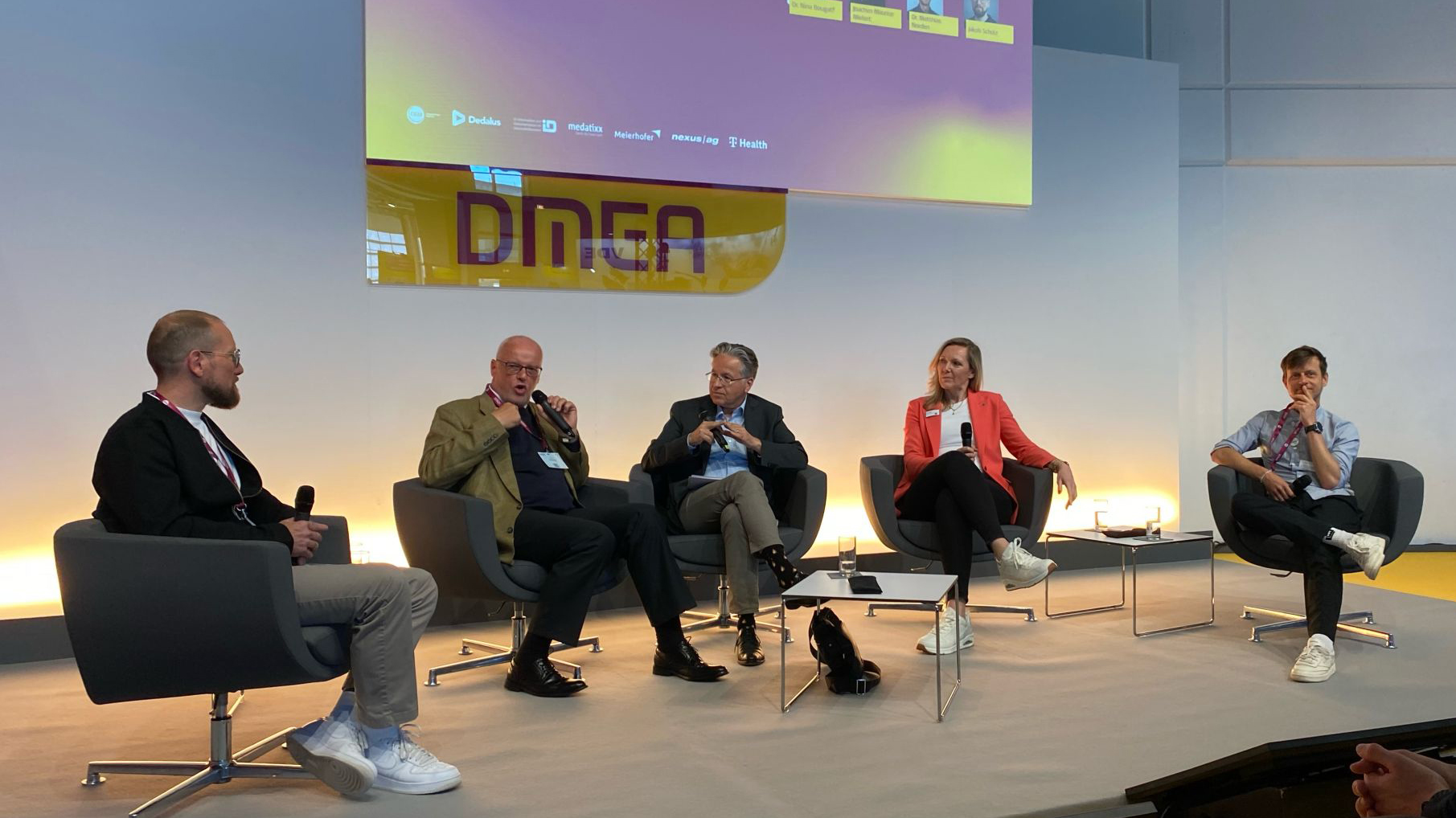
This is precisely where the expert panel moderated by Carsten Schmid, Head of Sales at nursIT Institute, came in at DMEA 2026: "From data silo to patient data room: how digital technologies are redefining healthcare."
(Note: At the end of this article you will find the complete 45-minute panel discussion as a video!)
Carsten Schmid opened the discussion with an image from everyday healthcare: those who accompany elderly relatives often compile folders, findings and medication plans. Not because no data is generated. But because they are stored in separate systems in the practice, hospital, laboratory, health insurance company or pharmacy.
Dr. Nina Bougatf (CGM Clinical)put it in a nutshell from a manufacturer and hospital perspective: there is not one patient data room, but many data rooms in different sectors. The actual patient data room must first emerge from the merging of these rooms.
Dr. Matthias Norden (mio42) expandedthe term in the panel to a "patient universe": rooms with open doors that speak a common language. This is where the real work begins. Because data exchange is not just a technical issue. It is a question of shared meaning.
This fits in with the development of the electronic patient record. The ePA for all was launched on January 15, 2025; after the pilot phase, the nationwide rollout began on April 29, 2025. Practices, hospitals and pharmacies have been obliged to use it since October 1, 2025. At the same time, the discussion shows that a file alone does not make a data room. A central repository does not replace a care logic.
One of the most important sentences of the panel came from Dr. Nina Bougatf: Technical structuring is not enough. A value such as "80 kg" alone is not medically useful information. The context is crucial: is it a birth weight, an admission weight, a discharge weight or a measured value over time?
That sounds banal, but it is crucial. In healthcare, meaning is not automatically stored. It often arises in conversation, in the situation, through the implicit knowledge of doctors, nurses, therapists or social services. If this context is not properly modeled, another service provider may later misinterpret the data - or not use it at all.
As Carsten Schmid put it after the forum on LinkedIn: "Without context, data is worthless." It is only through semantic classification that data becomes information and information becomes relevant for decision-making. In his contribution "From data silo to real decision-making basis - where do we really stand?", he concludes that technology is no longer the bottleneck. The real challenge lies in context, governance and collaboration.
This is precisely why standards such as MIOs, FHIR or LOINC are not technical side issues, but a prerequisite for care. The KBV describes Medical Information Objects, or MIOs for short, as standardized information modules for the ePA which, unlike PDF documents, can be further processed. The aim is to make information in practices, hospitals and pharmacies readable and editable across systems. LOINC, on the other hand, is an international standard for identifying health measurements, observations and documents.
Or to put it more simply: a PDF can be read. A semantically structured data set can be understood, checked, processed and integrated into decisions.
Jakob Scholz, (KV Westfalen-Lippe), soberlydescribed the initial situation in the outpatient sector: practice management systems have historically developed strongly from the billing logic. For a long time, they were less medical information systems than administration and billing systems.
Nevertheless, Scholz sees the first applications that generate real benefits. In the discussion, he described the electronic medication list in particular as a kind of "killer application" of the ePA: where structured data directly helps in everyday life, it is also used - even by doctors who are otherwise skeptical about the telematics infrastructure.
The example is well chosen because it shows both progress and limitations. The electronic medication list can provide a quick overview of prescribed and dispensed medicines. But it is not a complete picture of drug therapy. Over-the-counter medicines, preparations purchased abroad or analogously prescribed medicines may be missing.
This reveals a central truth: the ePA is an important building block. But a patient data room is only created when data quality, roles, responsibility, workflows and regional care pathways are considered together.
Carsten Schmid has sharply formulated this gap in another LinkedIn post: "Germany is discussing healthcare data rooms as if they were an IT project. That's exactly the problem." In his post "Germany discusses healthcare data rooms as if they were an IT project", he describes the real challenge not as a data problem, but as a governance problem. As long as hospitals, surgeries, care providers, payers and politicians think in terms of their own financing and control logics, every patient data room will remain "another digital project with no effect on care".
This is uncomfortable, but it gets to the heart of the debate. Because patient centricity is easy to say. It only becomes real when someone is responsible for the entire patient pathway.
Joachim Mielert , who introduced the patient and patient safety perspective to the panel, reminded the audience that trust is the key currency. Patients must be able to understand what happens to their data, who has access to it and what benefits they derive from it.
His image of the analog file folder was more than just nostalgia. For many people, a folder with a hole punch and index is easier to understand than a landscape of apps, authorizations, document types and different interfaces. Anyone who is serious about digitalization must not treat the user interface as a minor matter. For patients, this is where it is decided whether trust arises from data - or excessive demands.
Mielert's guiding principle is therefore: patient safety. Data saves lives, but only if it is available at the right moment, understandable and relevant for action. This also includes shared decision making: doctors, pharmacists, nurses and patients must be able to talk on the basis of shared information.
Jakob Scholz added an important nuance: patient empowerment also means accepting that some patients do not want to actively manage their data themselves. Older or less digitally savvy people in particular must still be able to benefit. An ePA must not only help those who operate an app, set authorizations and actively curate documents. It must also be effective in the healthcare context.
After the DMEA, Carsten Schmid drew a personal conclusion on LinkedIn: "Lots of AI - little intersectorality." Despite much optimism, he had seen too few solutions that consistently support collaboration between inpatient, outpatient and nursing care - especially in treatment documentation along the entire patient journey.
From nursIT's point of view, this is precisely where one of the crucial points lies. The future of healthcare is not being created within individual sectors. Hospitals are setting up MVZ structures, outpatient and inpatient services are shifting, nursing care is becoming more closely integrated into regional care, and models such as Hospital at Home show that care must increasingly take place where the patient is - not where the system boundary is.
The hospital reform also points in this direction. Cross-sector care facilities are to combine inpatient, outpatient and nursing services close to the patient's home. Digitalization and AI are also mentioned as building blocks for further developing documentation and data collection.
However, if documentation continues to end at the sector level, care will remain fragmented. Then we are not digitizing the patient pathway, but only individual wards on this pathway.
The European Health Data Space, or EHDS for short, is increasing the pressure for change. The EHDS regulation was published in March 2025 and came into force shortly afterwards. Key application steps will follow in stages: From 2029, patient summaries, electronic prescriptions and dispensing data, among other things, are to be exchangeable across the EU; medical images, laboratory results and hospital discharge reports are to follow from 2031.
This means that interoperability will no longer remain just a German reform goal. It will become a European obligation. But here too, regulation creates framework conditions, not a culture of care. The EHDS can open doors. The players themselves have to go through them.
The panel discussion shows three tasks that now belong together.
Firstly, data must become semantically usable. Structure alone is not enough. Health data needs context, standardization and medical meaning.
Secondly, data must be integrated into workflows. Doctors, nurses, pharmacies and other service providers will only accept digital applications if they make everyday life easier and improve decisions.
Thirdly, data rooms need governance. Without shared responsibility, common goals and a common care logic, data rooms remain technically impressive but practically ineffective.
Carsten Schmid sums up this attitude in his LinkedIn post "From data silo to real decision-making basis - where do we really stand?": "The patient data room is not created by systems, but by coordinated action."
This is perhaps the most important sentence of the entire debate.
Because the path from data silo to patient data room is not just an IT project. It is an organizational project. A cultural project. And above all: a care project.
For nursIT, this means that digital documentation must no longer only support individual facilities. It must be able to connect to regional, intersectoral and patient-centered care. It is about systems that not only record data, but also make it usable along the patient journey - for care, medicine, therapy, management and patients themselves.
The full discussion in the video shows how much is already in motion, but also how honestly the industry needs to talk about its construction sites. It is precisely this honesty that makes the panel worth watching.
Because the crucial question is no longer: Do we have enough data?
The crucial question is: Are we ready to organize supply in such a way that this data can finally take effect?
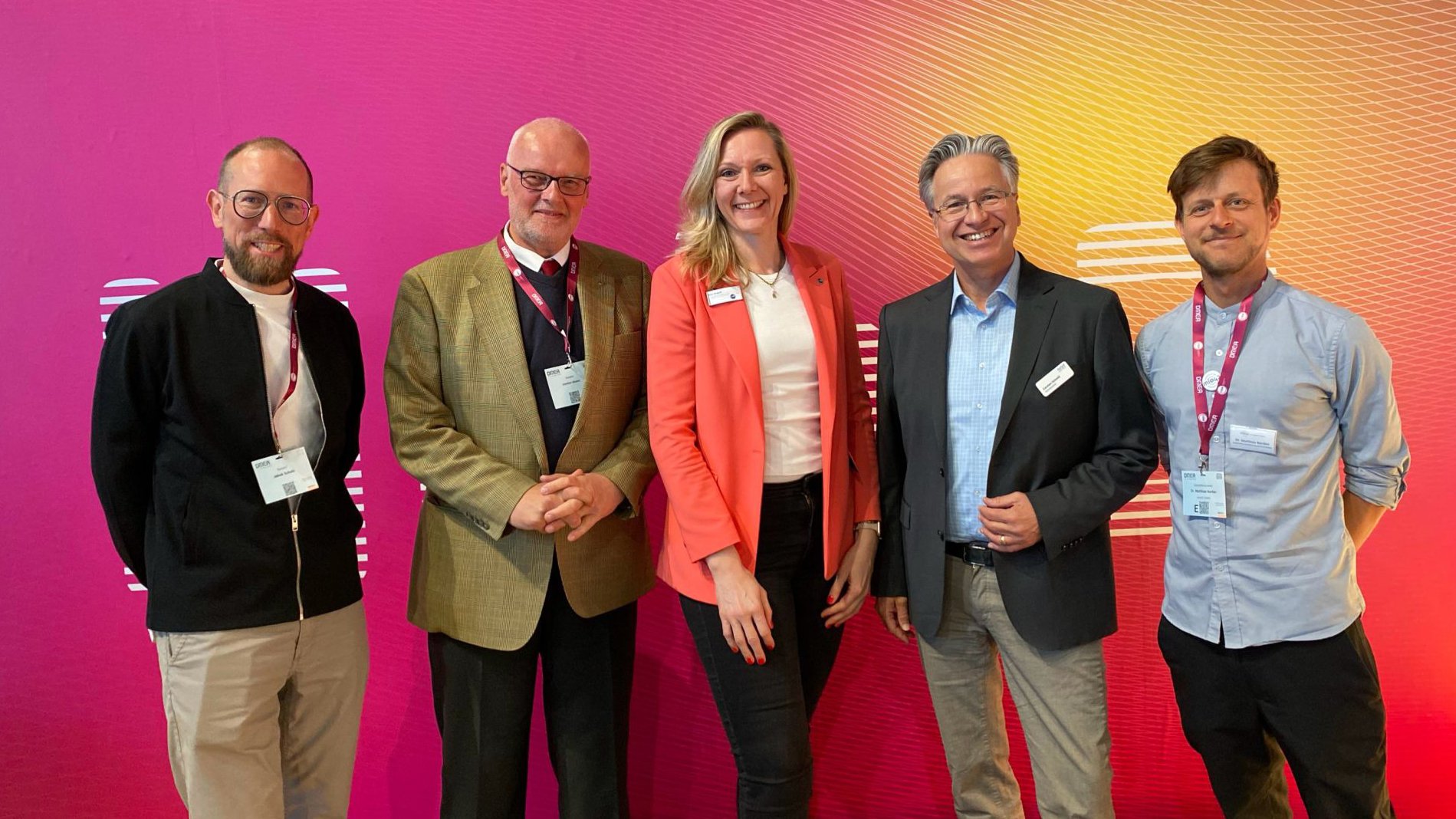
Want to dive deeper into the arguments of Dr. Nina Bougatf, Dr. Matthias Norden, Joachim Maurice Mielert and Jakob Scholz? Experience the dynamics of this honest and groundbreaking debate for yourself. Credit: DMEA
Finally, we would like to thank everyone involved in this open and remarkably nuanced discussion.
Many thanks to the panelists:
Special thanks also go to the Bundesverband Gesundheits-IT - bvitg e. V. for organizing and holding the forum and to the DMEA as a platform for precisely the discussions that the healthcare system needs now: honest, cross-sectoral and with a view to real care instead of pure digitalization rhetoric.
1 min read
nursIT Editorial Team : May 23, 2026, 10:48:07 AM
Why voice AI in care must be able to do more than transcribe
1 min read
nursIT Editorial Team : Jan 30, 2024, 12:47:10 PM
The NursIT Institute is excited to be represented at the prestigious Arab Health Exhibition 2024 in Dubai. Our managing directors, Stoyan Halkaliev...
1 min read
nursIT Editorial Team : Feb 19, 2026, 8:36:20 AM
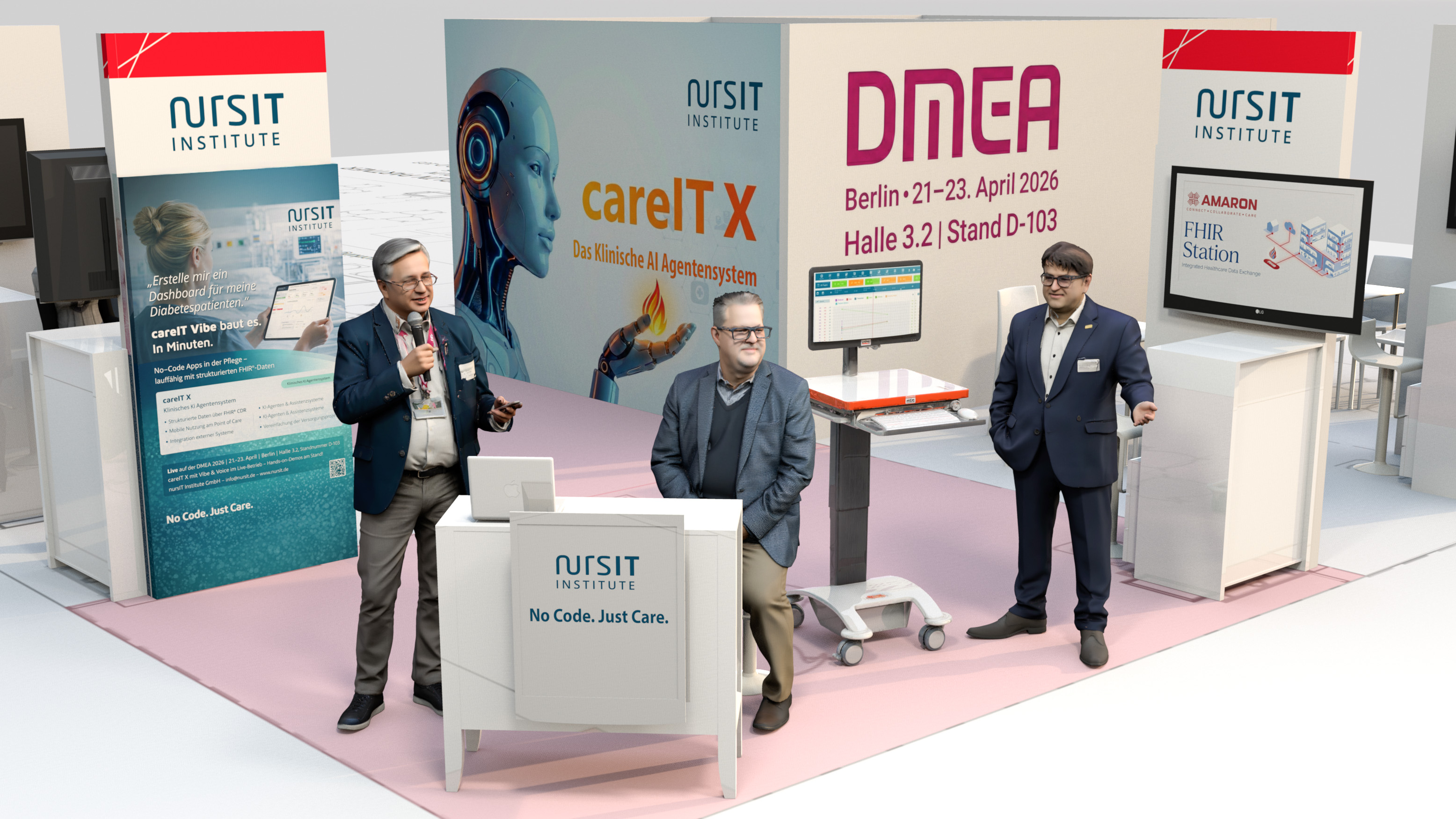
Experience the paradigm shift at DMEA 2026 Berlin, February 2026: NursIT presents CareIT X and invites journalists and hospital professionals to...