Field-Proven & future-proof
Tried and tested in numerous hospital projects - scalable and standard-compliant.
powered by nursIT & Smile™ Digital Health
We implement FHIR productively in German hospitals—ISiK-compliant, GDPR-secure, and scalable. Drawing from numerous projects, we ensure that HL7® v2, FHIR (R4), SNOMED CT, LOINC, and ICD-10 are integrated with technical precision and semantic consistency.
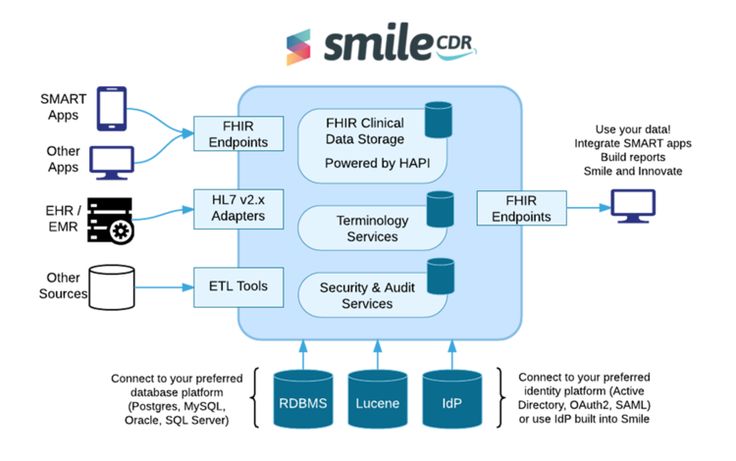
Storage of clinical information according to HL7 FHIR (R4) - version-safe, traceable, usable for documentation, analysis and decision support.
Connection via HL7 v2 or REST APIs. nursIT ensures correct processing and semantic consistency – including embedding of unstructured content (e.g. PDFs from MDM).
Supports SNOMED CT, LOINC and ICD-10 – comprehensible, comparable and analyzable across systems.
Role-based access management, central authentication, complete logging – on premise, GDPR-compliant.
With Smile CDR, clinics create the basis for an interoperable and sustainable data architecture for modern care. At the same time, Smile CDR creates a standardized database for clinical research, quality assurance and data-driven analyses – always under the full control of the clinic.
Structured recording, storage and provision of health data - as an integral part of digital treatment and care processes.
Standardized interfaces connect HIS, MDM and specialist systems to form a consistent database.
Consolidated, locally stored information for quality assurance, process control and studies - without external cloud services.
Foundation for real-time monitoring, clinical decision support and AI analysis. Allows customized FHIR front ends from simple dashboards to complex applications such as careIT for use directly at the point of care.
As a database for our KAS careIT or as a stand-alone platform, Smile CDR connects systems, harmonizes information and ensures the exchange and reusability of clinical data across system boundaries - for long-term usable health data.
Tried and tested in numerous hospital projects - scalable and standard-compliant.
Supports FHIR, HL7, SNOMED CT and LOINC – manufacturer-independent and ISiK-compliant.
Local processing and storage – GDPR-compliant and with transparent access control.
Integrate Smile CDR into your IT structure without major changes – with support from nursIT experts.
Modular platform for future digital and AI-based applications.
FHIR (Fast Healthcare Interoperability Resources) is an international HL7 standard for the structured exchange of healthcare data.
FHIR uses modern web technologies (e.g. REST APIs, JSON, XML) and creates a future-proof basis for digital patient records, clinical data platforms and interoperable software solutions in the healthcare sector.
HL7 v2 has been used worldwide for the exchange of medical data for many years, but is technically complex and often interpreted differently.
HL7 FHIR works with resource models and web technologies and thus enables a more flexible, better interoperable data exchange - ideal for modern hospital IT, clinical data repositories and national platforms.
Smile CDR is a Clinical Data Repository (CDR) that is fully based on the HL7 FHIR standard and securely stores, harmonizes and provides interoperable clinical data.
It serves as a central data platform for care, research and AI-supported analyses and forms the basis for modern, interoperable healthcare IT.
A FHIR-CDR:
Stores data in a standardized and structured way,
integrates information from different clinical systems,
enables interoperable access via FHIR APIs,
supports analysis, reporting and AI processing.
In contrast to proprietary individual databases, this creates a standardized, future-proof data platform.
Yes, existing HL7 v2 interfaces can continue to be used and integrated into a modern FHIR architecture.
ISiK (Interoperability Standard for Information Systems in Hospitals) defines binding gematik requirements for data exchange in hospitals. ISiK-compliant means that these requirements are met.
This includes standardized interfaces, FHIR support and defined security mechanisms. ISiK-compliant systems are future-proof and designed for modern hospital IT architectures.
SNOMED CT, LOINC and ICD-10 are international terminologies and classifications that standardize medical terms. FHIR defines the structure and transfer of the data - together they ensure semantically clear, interoperable information.
SNOMED CT: clinical terminology for the precise description of medical concepts (diagnoses, findings, measures).
LOINC: Standard for laboratory and measured values such as blood parameters or vital data.
ICD-10: Classification system for coding diagnoses for documentation, statistics and billing.
In combination with FHIR, a basis for high-quality, analyzable data is created - essential for digital care, research and AI-supported analyses.
Yes, Smile CDR can be operated entirely on premise, is GDPR-compliant and can be adapted to national legal frameworks in Europe.
This makes the platform ideal for clinics and healthcare networks in Germany, Austria, Switzerland and the EU that value data sovereignty and legally compliant processing.
nursIT provides hospitals with comprehensive support in the planning, implementation and operation of a FHIR-CDR – from architecture to go-live.
Would you like to find out more about FHIR smile CDR or plan a project? Contact us – we will be happy to assist you with the design and implementation.